The Course Report as written by the participants
Background
This report is prepared with the purpose of giving a comprehensive overview of the programme and the results from the evaluation of Finding Your Voice Training Course realised in Germany in October 2025.
The course report has been created collaboratively by the participants of the training and the evaluation results reviewed by the training team.
The Context:
Finding Your Voice is an Erasmus+ training course designed for passionate youth workers, artists, educators and change makers.
This unique course invites you to discover the revolutionary power of singing and vocal expression as a dynamic methodology for youth work. You will gain practical, creative tools to empower young people to boost their self-esteem, foster personal growth, and foundations to actively engage them in democratic processes, helping them find their own voice for change, inspired by the potent legacy of protest songs.
More than just professional development, this course offers a chance to experience the joy and power of your own voice and connect with a vibrant international network of expressive peers.
Finding Your Voice is a training course that offers an opportunity for youth workers and those working with young people the opportunity to explore and develop the use of voice and singing as a methodology for promoting democratic participation.
The connection between music and politics, particularly political expression in song, has been seen in many cultures. Although music can influence political movements and rituals, it is not clear how or to what extent general audiences relate to music on a political level. Music can express anti-establishment or protest themes, including anti-war songs, but also pro-establishment ideas can be represented. From the ‘singing revolution’ across the Baltic countries to the punk anti-establishment of the 70’s and more recently of Pussy Riot in Russia, music and song seem to lend itself well as a platform for protest. More recently the social media phenomena of TikTok has also become an outlet for sharing opinions through song.
How as youth workers can we encourage the young people we work with to explore and engage as active citizens in the democratic process and find their political voice?
This training wants to firstly explore the benefits of singing as a youth tool and methodology. How can we utilize singing for promoting self confidence and developing positive self esteem and other youth work priorities such as teamwork, problem solving and cultural expression.
We will then look to explore the power and influence of the ‘protest song’ and how we can use singing for promoting democratic participation. While throughout the training developing our own development and expression through working on our own voice.
The Training Courses Overall Aim:
To empower youth workers and those working with young people to harness the transformative potential of singing and vocal expression as a means to enhance personal development, communication skills, active citizenship, and leadership abilities. This course seeks to enable participants to not only discover the joy of singing but also to recognise its value as a tool for personal growth and social change. Equipping youth workers with tools to actively engage young people in developing essential skills for active participation, civic and democratic responsibility, pathways to employability and/or education through a new found confidence in expressing themselves through using their voice.
The main objectives of the course are:
- Discover the pleasure of singing and using your own voice
- Explore the power of using your own voice to express thoughts, emotions, feelings and intentions
- Understand how singing can be used as a personal development tool helping to increase self-esteem and perception
- Explore how singing can be used to encourage active listening, cooperation and dialogue in our work with young people
- Define through the dynamics of singing a positive approach towards leadership and development of skills
- Identify approaches to dialogue, political change, active citizenship, and the conveyance of messages through song that can support our youth work
The training course was a KA1 project applied for by Beasily and the training team consisted of: Mafalda Morganti (IT), Ollie Clubb (UK) and Buzz Bury (UK)
We had 30 participants from: ITALY, GREECE, SPAIN, SLOVENIA, CZECH REPUBLIC, GERMANY, TURKEY, POLAND, LITHUANIA, FINLAND and HUNGARY
Arrival
Agenda:
- Arrival - Settling in
- Dinner
- Welcome and Introduction to Service & Care
Participants arrived throughout the afternoon, and early evening. German trains and connections were not helping the arrival of our participants. So we were happy to see everyone arrive ok.
Participants were welcomed and invited to find their bedrooms, prepare their beds and also create a dinner card, with their name and country on one side and 'enjoy your meal' in your own language on the other side.
Dinner was at 7.00 and after dinner we met briefly in the dining room and the training team introduced themselves again. We did a quick name round with a story about when the last song they sung in the shower and then invited to sign up for Service & Care.
Day 1
Service & Care - Federico
During the first morning of Service & Care we divided into the appointed groups to get the instructions on how to proceed for our daily tasks. We had the daily report as our first task, so here we are.
We decided to structure the daily reports assigning each activity for the day to a different person of the team, with another person doing a revision for them, or helping with the writing process if there is any difficulty writing in English. We wrote the reports in the notes of our phones and copied and pasted them to the Beasily blog, finally reading what the others wrote down and giving them eventual suggestions or corrections.
Getting to know each other -Ayça
After the service and care we got together in the other room. Firstly, we started with writing our names and we put it on our t-shirts. After that we said our names in different rhythm and we did this in loop. Additionally, we changed our place while we were singing our names. After that, we told some stories about why we came here. Also we wrote about some sounds which we remember and we categorized them. After that we talked about those sounds in groups. Lastly, we summarised our weekly plan.
Soundscape Walk
After a small break we were gathering outside the community house at 11:30 cause we were told that we are going for a walk. It wasn't too cold neither rainy, but everything was wet, yet perfect for a walk.
The first task was to find a partner and then Mafalda asked the first question:
What is one thing about the program that makes us feel curious/excited?
We were walking and talking. It was basically the continuation of the previous session "Getting to know each other". So we shared our thoughts about the question. After few minutes we had to stop talking.
The next thing was to chose another partner but we let fate to choose instead of us. We formed a circle and we had to look down. The task was when Mafalda said "now" we had to look at somebody and see if they are looking back to us or not. When not, you stayed at the circle, but when you did find someone then had to scream and you found your partner. And all over again and again until nobody were in the circle anymore. When we had the new pairs the next question was:
What might be challenging for you here?
The next way we made pairs was that we were forming a line by our names from A to Z. Every two people made a pair starting from A.
The next question was:
what would be your contribution for the week?
After that we had to form a line again but this time we had to form it by our month and day of our birth from 1st of January to 31th of December.
Our last question was:
How will it sound or look like success at the end of the program? What would make you feel successful?
When we were done with the talking we went back to form a circle in front of the community space. And the final task was to collect a sound what you like in your surroundings in the venue. You could also produce this sound. Then we went back and we were doing a reflection what just happened in this last session + We had to write down what were our wishes for this week on a cloud shaped paper and we sticked it to the wooden wall, so we can see and remember what we would like to happen.
Colour blind
Participants got blindfolded and were given a task. Each person was given a piece - they were in different shapes and colours. The goal was to figure out what 2 pieces are missing. It was an exercise in the topic of communication. During the task different leaders were coming up, group explored cultural differences and came to learn a variety of things about the group and individually.
Connecting body and voice
- We did meditative walking around the room
- We focused our attention and tried to feel the three layers of the body: the skeleton, the muscles and the skin
- We did meditative walking around the room again, but this time we also made a sound while exhaling and focused on vibrations within the body
- We made groups of two with a leader and a follower. One person was leading the other with an open palm around the space. Then the couples switched roles.
- We made groups of two with a leader and a follower. The leader was making noises and the follower was interpreting the sounds with spontaneous choreographic moves. Then they switched roles again.
- We made groups of two with a leader and a follower. The leader was improvising moves and the follower was interpreting the choreography in sounds. Then they switched again.
- We made six groups with one leader each. Like before the leader was improvising a choreography and their assigned groups interpreted the moves, each of them in their own unique way but also working as a team.
- The group was divided in two with one leader each. Each leader took a turn to perform a series of moves while their group interpreted the movements into noises. The goal was to tell a story through the interaction.
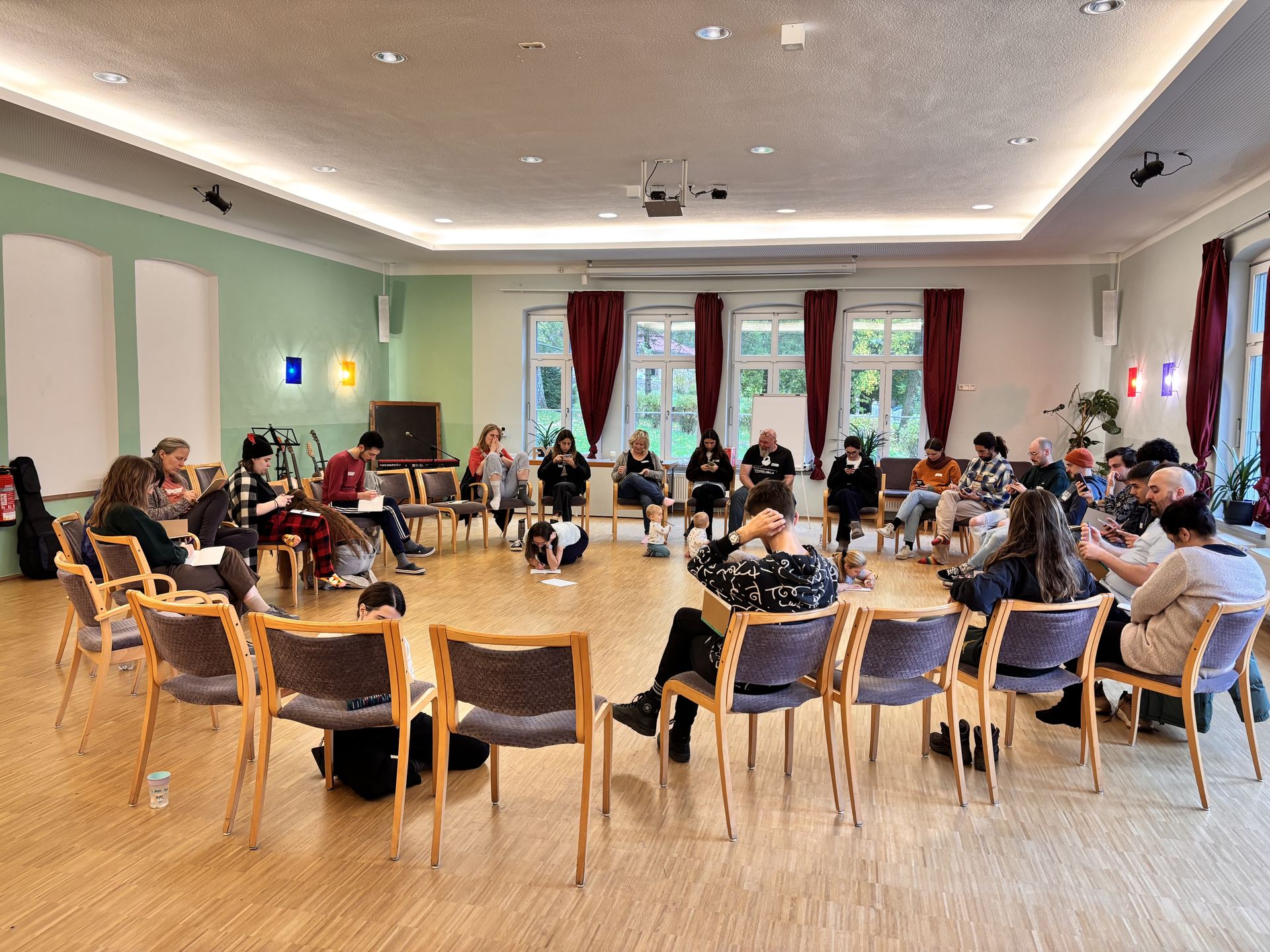
- The group discussed about their feelings and experiences about the process and afterwards everyone took their turn to summarise the exercise with one word.
Day 2
Service & Care
We are made of sound
Invite everyone to stand in a circle. Begin in silence — notice the air, the presence of others, your own breath.
Then introduce the simple, repetitive song “Balue Baluo” (a traditional call-and-response or round, depending on the version you use).
The gong activity “What do you give attention to?” invites participants to pause and notice where their focus naturally goes. With each gentle sound of the gong, they bring awareness to the body, breath, surrounding sounds, and inner feelings. The practice cultivates presence, calm, and a deeper sense of connection with oneself and the moment.
After the gong fades, gently shake your body to wake up your energy. Pat or tap your arms, legs, and shoulders to bring back feeling and warmth. Take a deep breath and notice how your body feels now — alive, grounded, and present.
Finding your Voice
Counting names (everyone in the circle has to say their name once, if two say theirs at the same time, we start from the beginning again)
Biggest fen (rock, paper, scisors in pairs; if you loose you become a fen of the one who one who won, the winner than compets with others until there is only one winner left and all of the other people are their fans)
Going into groups, method: different fruits)
Writing words on papers in groups (why, where, when, what do we sing?)
For whom do we sing (discution in groups,
every group gets a "for whom do we sing" (in memory, at campfire, at a match, prayer), has 10 min to write/prepare a song and then preform it, other guess what was written on the paper)
Something to say
We started this session with some engaging and fun warm-up exercises that got us using our voices and interacting with each other, creating the perfect setting for getting into circle song mode.
Using our bodies, our very own instruments, we started off working on beats and rhythms, each of us adding a layer to the cake until we had full full-bodied vibe circling the whole space. Adding harmonies, then phrases, we created a wonderful beehive of sound together.
We went on to pick up some of the intentions each of us set in the morning and experimented with a variation of theme-based circle songs.
youth participation
Creating a utopian country:
Grouping participants by choosing colourful post - it.
1. Five (5) groups choose for their own new country:
- a name
- a colour
- a flag
- a moto
2. Members of groups discuss about youth work as youth workers and what youth work of their utopian country youth work consists of.
3. Presentation of a scientific research by Unicef about 8 steps of youth participation starting from manipulation and expanding until YP - initiated decisions with adults. Call to groups to put the flag of their utopian countries in the desired youth work step of their countries.
4. Three facilitators in role are reporting live as journalists the manifestation of five (5) youth protests via five songs against five (5) youth works of five (5) utopian countries that created by groups if participants.
Notices:
- At the end of every part of session groups were presenting their work to everyone and discuss.
- Topics and issues about youth participation were put and were encouraged to be put on the table on a critical thinking spitrit and on a need for a real critical reconsideration spirit and not with preoccupated opinions.
games night
Pietro invites us to join a sharing circle about a specific topic. We can share our experiences, thoughts, or whatever feels true in the moment. It’s a space to listen deeply and connect with one another through open sharing.
Day 3
Service & Care
Global Sing Song x2
Global Sing Song Part 1
Reflection and Feedback
We began the day by reflecting on yesterday’s activities and sharing feedback in an open discussion. This helped us recognize our progress and identify areas for improvement as a group.
⸻
Warm-Up: Cows and Stables
Our warm-up session, Cows and Stables, brought energy and laughter to the group. It encouraged teamwork and prepared us for the creative activities ahead.
⸻
Local Masterclass with Levi and Márton
Levi and Márton led an inspiring local masterclass focused on sound types. We were learning about the chest voice, head voice, and the importance of breathing while singing.
⸻
Global Sing Song Part 2
After a short break, we formed our circle as usual. With Ollie's leadership we did vocal exercises and renewed our energy. Then we continued this activity with participants who wanted to take the lead. After this activity the group members came together again to create the songs of the utopian countries established yesterday. Each group completed the music of its own country, and afterward, we all sang every utopian country’s song together. Following this enjoyable session, Ollie shared some pictures and song from his previous project. Afterwards, we all sang a short song together and talked about and categorized what music meant to us.
History of Vocal Revolution x2
Film Night
Day 4
First session
Minigame about project voice. Everyone in a circle back to the center. Some in the center say "you" to someone, if that person back. That person exchange the position with the center
We make groups and discuss about the youth people frustration and the ways to express it. We make a flip chart with all the proposal. After that we make a little conversation about that all together
Moral compass
Sociograms - we have to choose between different topics, ( either cats or dogs, tee and coffe, shanghai or New york) wich are closer to our heart, than we took our place accordingly, and then list some arguments, why our side (like dogs) are better then cats.
Moral compass - we' drawn a circle with 8 parts, than filled them with names. These were our appiintments for short conversations about problems that frustrates us. Each talk lasted 5-10 minutes and at the end we made a #hashtag about a topic we were talking about.
Day 5
Morning
Warm-up exercises
Charlotte – “Everybody Who…?”
Participants sat in a circle with one person standing in the middle. That person called out a statement starting with “Everybody who…” — for example, “Everybody who had breakfast this morning.” Everyone who identified with the statement had to stand up and quickly change seats. The person in the middle tried to grab a seat, leaving another person without one, who then became the next caller. This playful game helped the group to get moving, pay attention, and connect through shared experiences.
Charlotte – “Europa: Clapping Body and Pairs”
Participants worked in pairs, facing each other. The sequence involved clapping on the thighs, then moving both hands up, left, or right. After clapping on the thighs again, both partners chose a new direction. Whenever both pointed the same way, they followed the thigh clap with a hand clap together before returning to the sequence. The exercise encouraged concentration, coordination, and non-verbal connection between partners.
Ollie – “Tam Tam Doobey” (Call and Response)
Ollie led rhythmic vocal exercises using call and response patterns. The group also repeated and explored songs such as Frère Jacques (in multiple languages), Canta Pajarillo / Little Bird / Petit Oiseau, and Let My People Go, practicing listening, timing, and multilingual singing.
Creative Exercises
Blackout Poetry
Each participant received a torn-out page from a book and selected words from it to create a short poem. The unused words were blacked out, leaving only the chosen words visible. This exercise encouraged creativity through limitation and individual interpretation. Participants would then pair up and share their poems with one another.
Rhyme Ladder
After the sharing, each of the participants found four rhyming words and created one sentence for each. Working in the already existing pairs, they tried to connect or blend their individual poems into a new shared version. This task promoted collaboration, improvisation, and linguistic creativity. The results were then shared with the entire group.
Theory of Protest Songs
Before beginning the songwriting activity, the group received a short reminder about the main features of protest songs. This brief input was meant to give quick inspiration and help everyone create their own song in a very limited time. The facilitator highlighted that a protest song works best when it has:
- A clear and emotional message about a social or political topic,
- Simple and memorable language that everyone can understand and sing along to,
- Repetition and rhythm to make the message strong and engaging,
- A sense of unity, showing how singing together can express collective values and emotions.
Along with these reminders, participants received some practical instructions:
They were encouraged to choose a simple melody they already knew, keep the structure easy, and focus on writing new lyrics that fit their chosen theme. The goal was not musical perfection but to express ideas clearly and collaboratively through song.
Preparation for the Creation of Protest Songs
After the short theoretical reminder, the group discussed which types of music could be suitable for a protest song. Four categories were suggested: Poem or Rap, Call and Response, Circle Song, and Choir.
Pieces of paper with these categories were placed in different corners of the room, and participants gathered around the style they felt most comfortable with or curious about.
Through eye contact and short exchanges, smaller working groups naturally formed. Each group then chose a theme for their protest song using a set of hashtags that had been collected the day before. These hashtags represented real issues and topics that were personally meaningful to the participants.
Anyone who found a hashtag that spoke to them could take the corresponding paper and start forming a group around it. Others who shared the same interest could join – but working alone was also possible for those who preferred an individual approach.
This process encouraged self-organization, personal expression, and collaborative creativity, ensuring that each song was rooted in genuine motivation and shared values.
Afternoon
Open Space
In the afternoon, the group participated in an Open Space session, where participants were encouraged to bring in their own ideas and explore different creative approaches. Each participant who wanted to contribute had about 45 minutes time for their workshop.
Kyriakos led activities focused on interaction, theatre, and warm-up games, helping participants to connect, build presence, and get comfortable moving and collaborating in the space. This included a movement activity where each participant created a gesture, and as people moved through the space, they gradually transformed their movement into that of others.
Charlotte guided several exercises promoting creativity, body awareness, and musicality:
- Transforming numbers into sounds
- Improvisation games
- An exercise in which one participant spoke in a made-up language, while another “translated” it
- Introduction to Capoeira, combining rhythm, movement, and play
Levi, with piano support, conducted vocal training, including both practical exercises and theoretical insights on how tones resonate in the body, how to feel them, and how to open resonance spaces. These exercises enhanced vocal control, awareness, and expressivity.
Pietro led circle song activities, directing the rhythm and melody to develop ensemble awareness. He then guided the group through Haitian songs in Creole using a call-and-response format, experimenting with rhythm and dynamics.
Overall, the afternoon Open Space offered a rich variety of experiences, encouraging collaboration, active listening, creative risk-taking, and musical development. Participants explored their voices, bodies, and improvisational skills while learning from each other in a supportive environment.
Presentation of Protest Songs
The day concluded with the presentation of the protest songs on a real stage, complete with lights, spotlights, and three microphones. The performances showcased a wide variety of formats and approaches, reflecting the creativity and dedication of the participants:
- Spoken word poems (2 groups)
- Well-developed pieces featuring singing, piano, and guitar
- A group that integrated active silence into their protest, creating a powerful artistic statement
- Comedic interpretations
- A combination of singing and poetry in dialogue, performed in front of a background of silent protest
- A call-and-response piece
Observations:
The diversity of topics and artistic expression was remarkable. The audience was fully attentive, listening with genuine interest, and absolutely supportive, creating a safe and encouraging space for the performers.
After the official program, participants continued with informal music-making and karaoke, extending the sense of community and shared creativity beyond the structured activities.
Impact and Outcomes
- Collaboration: Participants learned to work together in small groups, improvising and coordinating ideas quickly and creatively.
- Musical and artistic development: The exercises, from vocal training to circle songs and songwriting, helped participants gain confidence in rhythm, voice, movement, and musical expression.
- Creative problem-solving: Limited time for songwriting encouraged focus, prioritization, and practical application of theoretical concepts.
- Social and emotional growth: The activities promoted empathy, active listening, and awareness of others, building trust and cohesion in the group.
- Cultural and linguistic exploration: Multilingual songs, Creole music, and diverse artistic formats broadened participants’ cultural awareness.
- Performance experience: Presenting songs on a real stage with full audience support provided a sense of achievement and reinforced the value of collective creative work.
The day successfully combined learning, collaboration, creativity, and reflection, leaving participants inspired and prepared for future collective projects.
Observations
The group included participants from 11 different countries and represented a wide range of ages, backgrounds, and levels of experience — from professional singers and theatre actors to participants with little or no prior musical training, from students to working professionals, with and without children.
Despite these differences, everyone found their place within the group. Those with more experience in music or performance naturally supported and encouraged others, sharing their knowledge in a generous and non-intimidating way. This created an atmosphere where learning, experimentation, and mutual support were valued more than individual skill or expertise. As a result, participants were able to grow together, learning both from and with each other in a genuinely collaborative and empowering environment.
This environment of curiosity, empathy, and cooperation allowed everyone — including more reserved participants — to contribute meaningfully, demonstrating how creativity can become a bridge for dialogue and inclusion.
During the protest song writing process, this sense of openness and mutual respect became especially visible. Participants shared personal views and experiences, but rather than debating or trying to convince others, they focused on listening, understanding, and finding common ground. The creative process turned into a collective exploration of what connects people across cultures and perspectives. The songs that emerged reflected this unity — combining different voices, languages, and artistic ideas into shared expressions of hope, justice, and togetherness.
Day 6
Review of performance - Harvesting
We started the day by singing together in a circle to connect with each other and ground ourselves. Afterwards, we divided into smaller groups in such a way that people who had not performed together the previous day were placed in different groups. Each group reflected on different aspects of the process – process, people, and product – and discussed which of these aspects felt most important for them. Then we marked our priorities on a flipchart and gathered again for a feedback round, where participants openly shared their frustrations and reflections, followed by an honest and constructive discussion with the trainers.
The first session continued with sharing feedback about yesterday’s performance. The facilitators prepared a flipchart with instructions on how to give and receive feedback. It included reminders such as “don’t take things personally,” “reject what doesn’t work for you,” and “speak from the heart.” We also mentioned the sandwich method, starting with appreciation, then giving constructive feedback, and finishing with something positive again.
This was done in the goldfish framework: participants were sitting in a large circle, with four chairs in the center. At any moment, anyone could join or leave the inner circle, and those sitting there were sharing their feedback. We discussed a variety of topics, from the diversity of approaches in performances to technical details and concerns. The feedback circle lasted about 45 minutes.
Action Planning
The next part of the morning was dedicated to creating our action plans – what we want to implement after returning home from the training course. We had five minutes to reflect individually on whom we want to share the new knowledge with, and then we stood in a circle where anyone could share their ideas with the whole group.
Afterwards, we divided into small groups of three to discuss what do I need to make it happen, when can I do it, and how much support or resources do I need. Then each of us wrote a short intention statement on a cloud-shaped paper, summarizing our plans, and shared it with everyone in the circle. We closed this session and enjoyed a well-deserved lunch break.
Soundscape for the Week
After lunch, we had a short energizer, a rhythmical group game with phrases like “one duck, two legs, quack,” “two ducks, four legs, quack quack,” and so on. Everyone had to say one word at a time, which quickly led to laughter and playful chaos.
Then we went outside for a Walk and Talk activity in nature. Each person spoke with three partners, reflecting on three questions: what was the most meaningful moment of the project, what was the most challenging part, and how did I personally contribute to the group or project.
When we came back to the training room, we reflected on all the intentions we had set for the project, for ourselves, our families, our communities, and the world, and connected them with the plans we had just created for the future. We then sat in a circle, closed our eyes, and sang together in harmony.
Evaluation
The final session of the training course began with some logistic notes and a recap of the whole week, revisiting our arrival day, the main sessions, and the flow of the program. Since the week was so intense, it was beautiful to recall all the experiences we had shared.
Then a long sheet of paper was placed on the floor. For 20 minutes, everyone was invited to draw, write, or express themselves freely through words, colors, symbols, or song lyrics. By the end, the paper was full of vibrant drawings, quotes, and touching messages.
We closed the training with a collective singing of a call-and-response song, “Love Each Other.”
Farewell Evening
In the evening, we gathered again for our goodbyes, sharing tears, hugs, contact details, and writing secret messages to each other inside our name cards.
It was a warm, heartfelt ending to an intense and transformative week.
Evaluation
Coming soon .pdf